

Mauritius Inquiry Field Journal Excerpts
FIELD JOURNAL OF P. H. WAINWRIGHT
Mauritius Inquiry, 1893
Selected entries preceding the discovery of 17 August
The Search for Crowthers Bird
__
19 June 1893
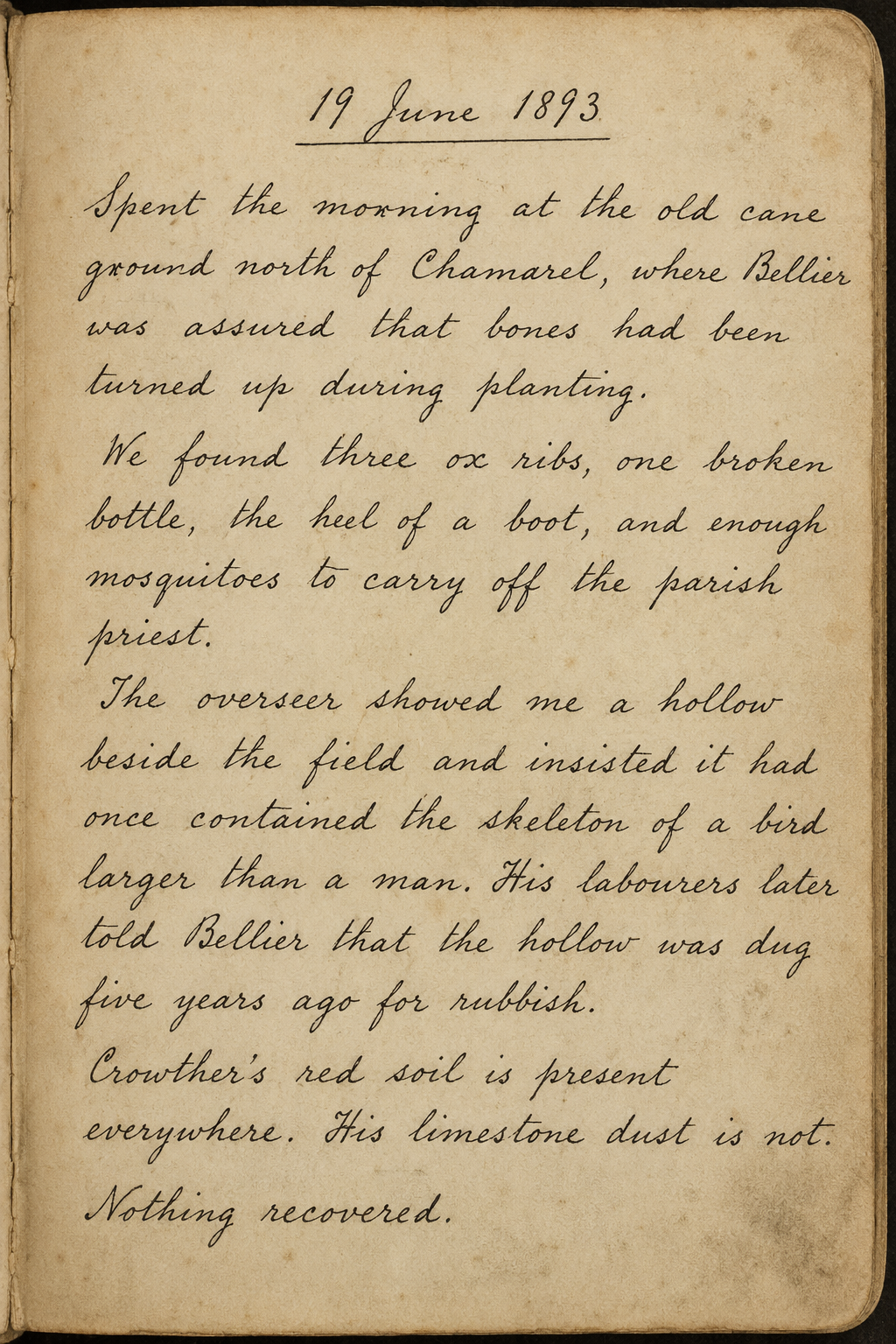
Spent the morning at the old cane ground north of Chamarel, where Bellier was assured that bones had been turned up during planting.
We found three ox ribs, one broken bottle, the heel of a boot, and enough mosquitoes to carry off the parish priest. The overseer showed me a hollow beside the field and insisted it had once contained the skeleton of a bird larger than a man. His labourers later told Bellier that the hollow was dug five years ago for rubbish. Crowther’s red soil is present everywhere. His limestone dust is not.
Nothing recovered.
__
27 June 1893
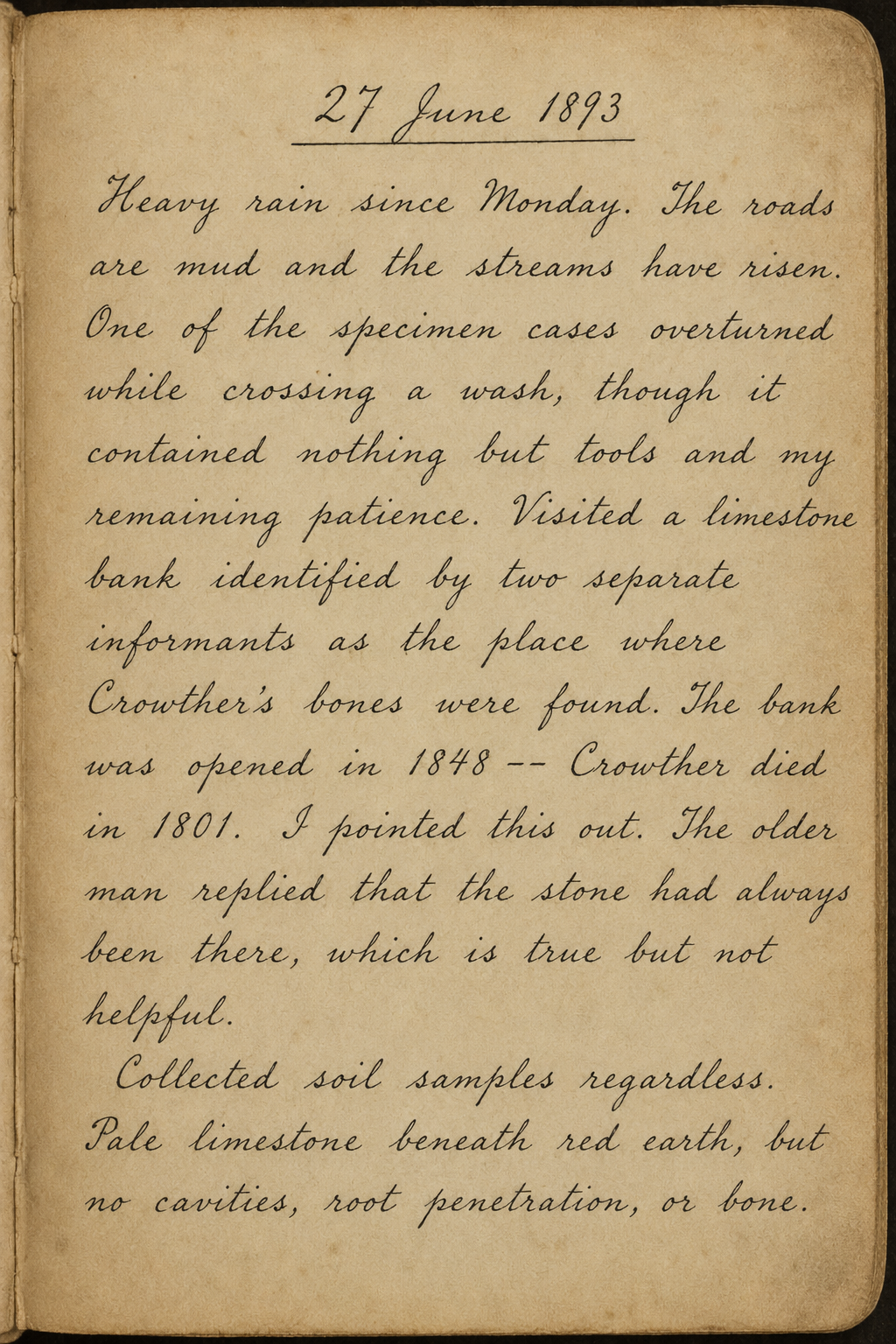
Heavy rain since Monday. The roads are mud and the streams have risen. One of the specimen cases overturned while crossing a wash, though it contained nothing but tools and my remaining patience. Visited a limestone bank identified by two separate informants as the place where Crowther’s bones were found. The bank was opened in 1848 -- Crowther died in 1801. I pointed this out. The older man replied that the stone had always been there, which is true but not helpful.
Collected soil samples regardless. Pale limestone beneath red earth, but no cavities, root penetration, or bone.
__
4 July 1893
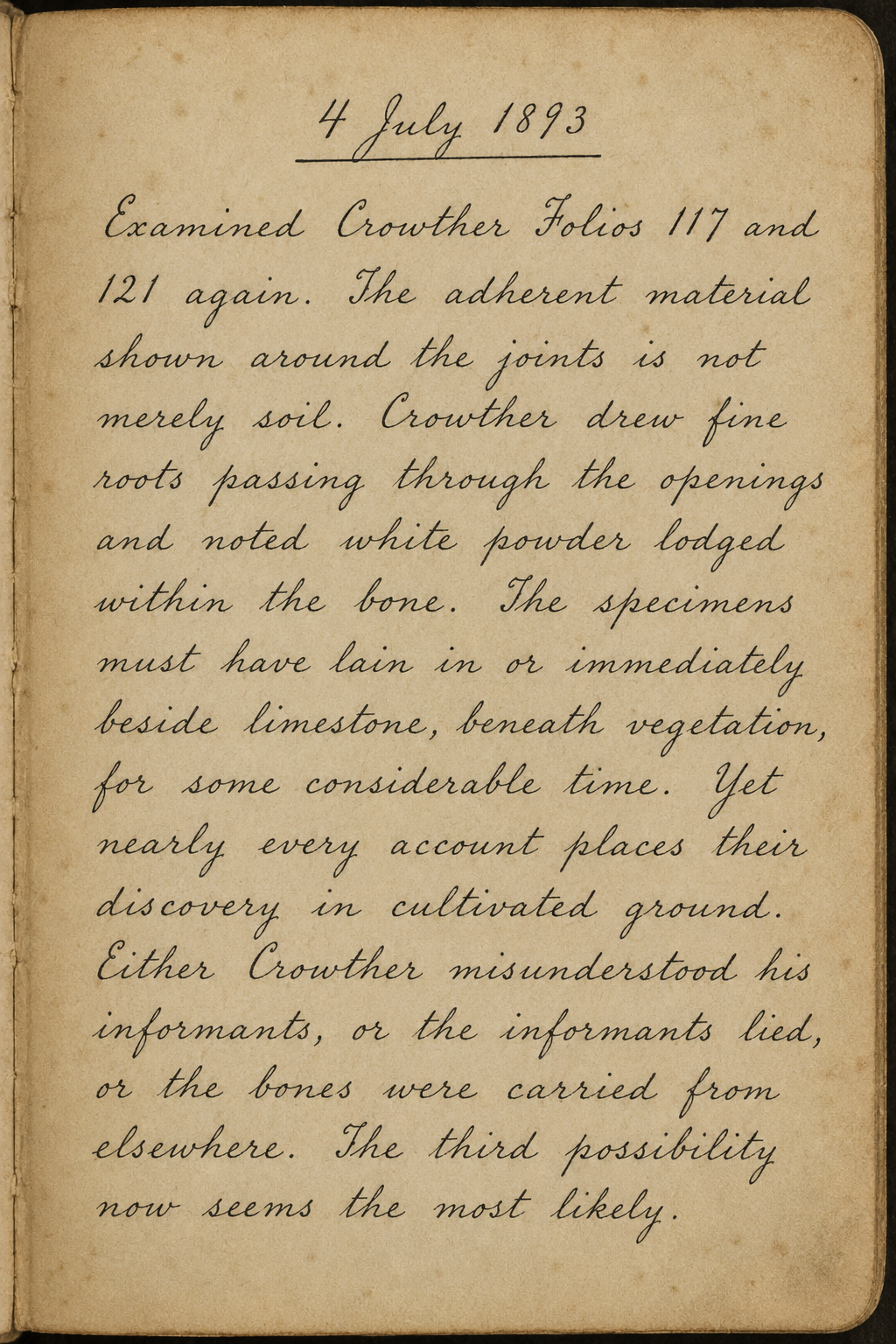
Examined Crowther Folios 117 and 121 again. The adherent material shown around the joints is not merely soil. Crowther drew fine roots passing through the openings and noted white powder lodged within the bone. The specimens must have lain in or immediately beside limestone, beneath vegetation, for some considerable time. Yet nearly every account places their discovery in cultivated ground. Either Crowther misunderstood his informants, or the informants lied, or the bones were carried from elsewhere. The third possibility now seems the most likely.
__
12 July 1893
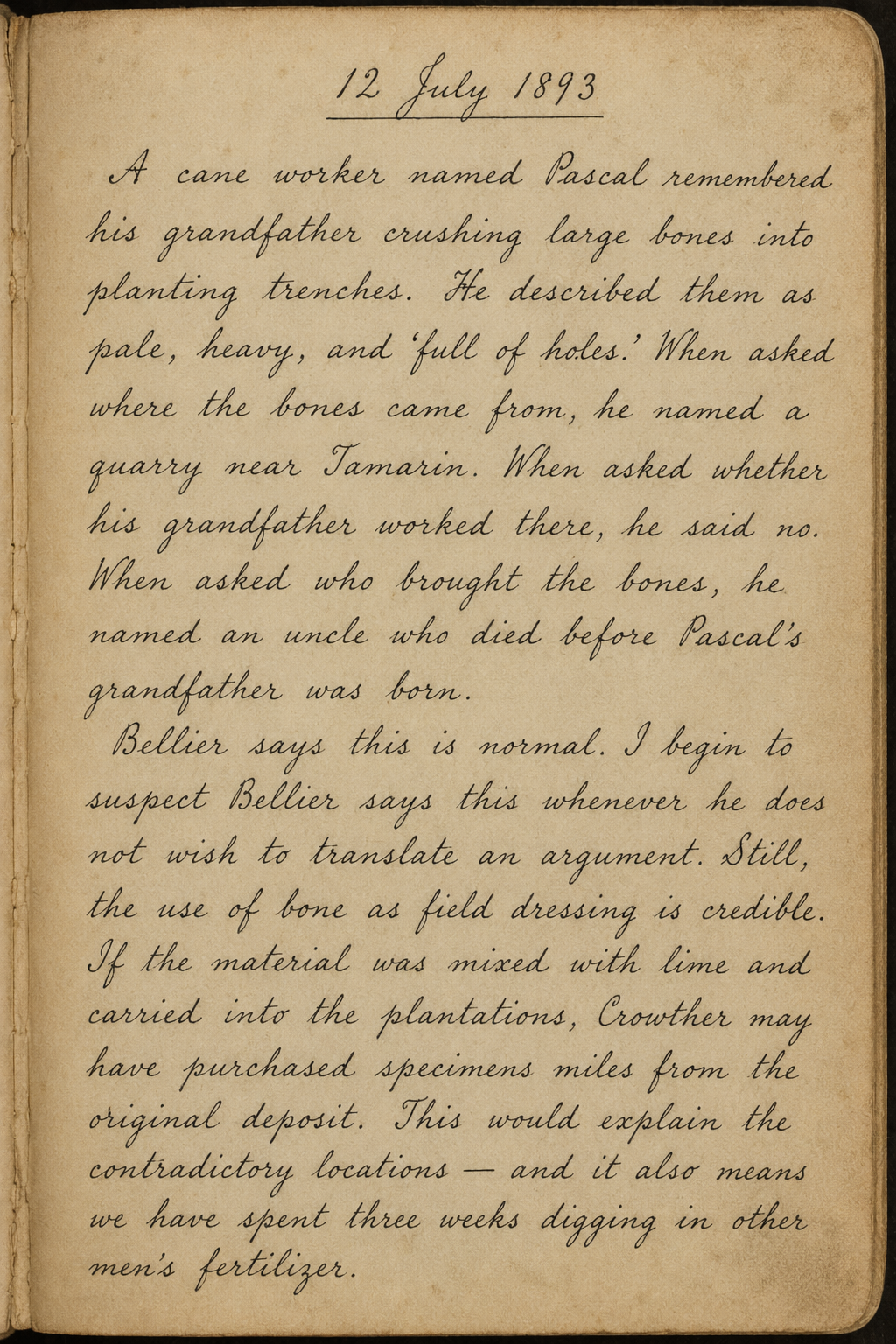
A cane worker named Pascal remembered his grandfather crushing large bones into planting trenches. He described them as pale, heavy, and “full of holes.” When asked where the bones came from, he named a quarry near Tamarin. When asked whether his grandfather worked there, he said no. When asked who brought the bones, he named an uncle who died before Pascal’s grandfather was born.
Bellier says this is normal. I begin to suspect Bellier says this whenever he does not wish to translate an argument. Still, the use of bone as field dressing is credible. If the material was mixed with lime and carried into the plantations, Crowther may have purchased specimens miles from the original deposit. This would explain the contradictory locations — and it also means we have spent three weeks digging in other men’s fertilizer.
__
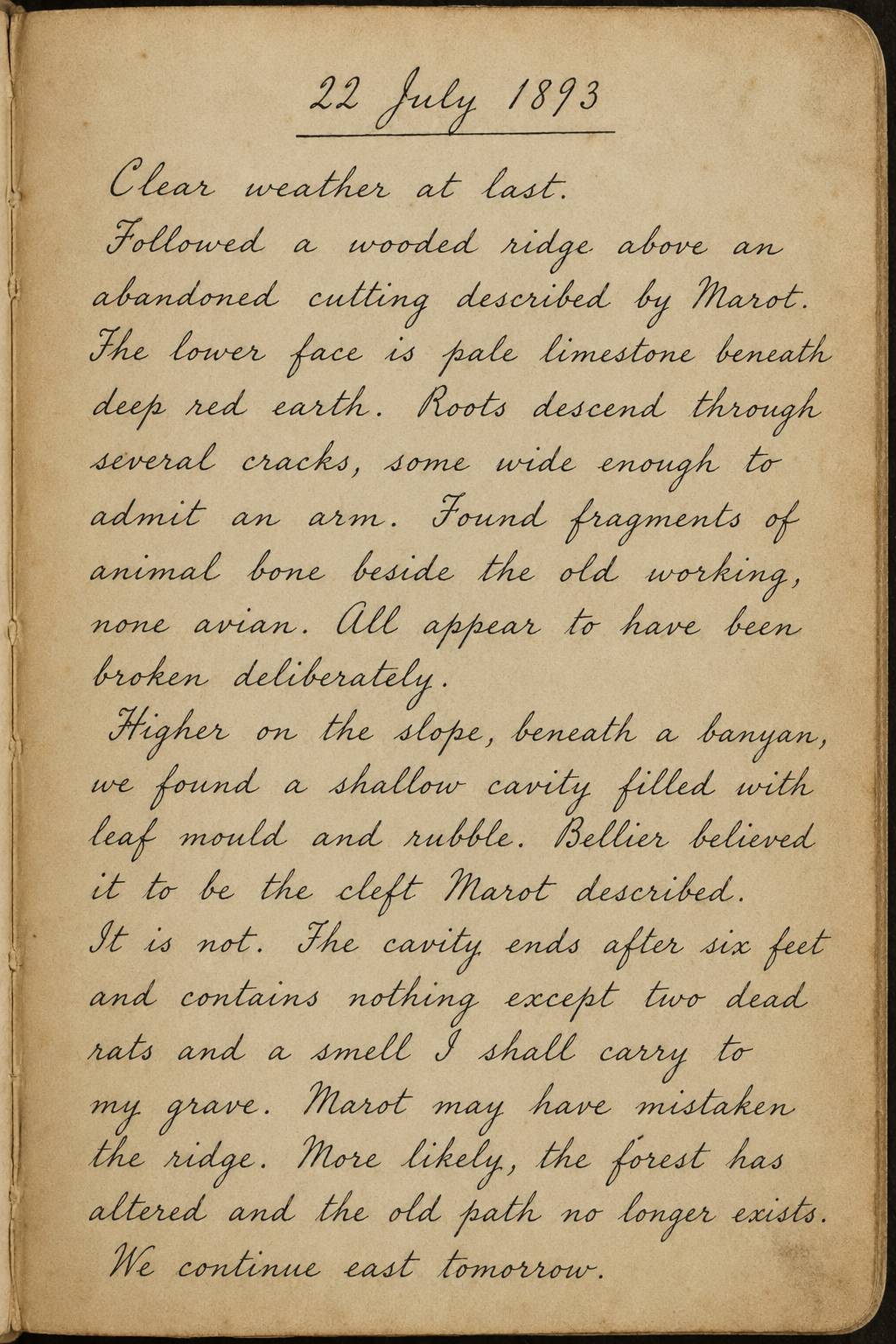
22 July 1893
Clear weather at last.
Followed a wooded ridge above an abandoned cutting described by Marot. The lower face is pale limestone beneath deep red earth. Roots descend through several cracks, some wide enough to admit an arm. Found fragments of animal bone beside the old working, none avian. All appear to have been broken deliberately.
Higher on the slope, beneath a banyan, we found a shallow cavity filled with leaf mould and rubble. Bellier believed it to be the cleft Marot described. It is not. The cavity ends after six feet and contains nothing except two dead rats and a smell I shall carry to my grave. Marot may have mistaken the ridge. More likely, the forest has altered and the old path no longer exists.
We continue east tomorrow.
__
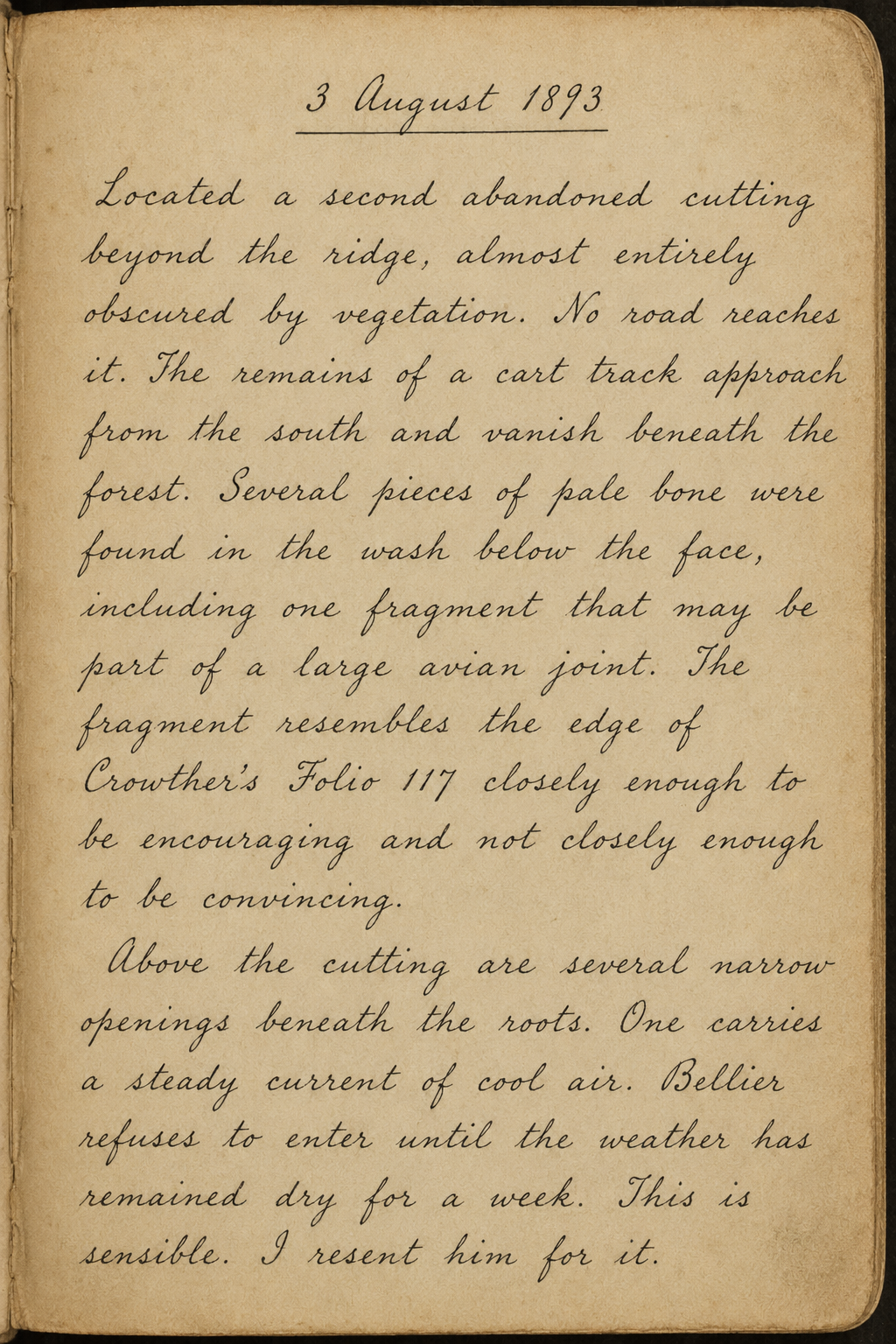
3 August 1893
Located a second abandoned cutting beyond the ridge, almost entirely obscured by vegetation. No road reaches it. The remains of a cart track approach from the south and vanish beneath the forest. Several pieces of pale bone were found in the wash below the face, including one fragment that may be part of a large avian joint. The fragment resembles the edge of Crowther’s Folio 117 closely enough to be encouraging and not closely enough to be convincing.
Above the cutting are several narrow openings beneath the roots. One carries a steady current of cool air. Bellier refuses to enter until the weather has remained dry for a week. This is sensible. I resent him for it.
__
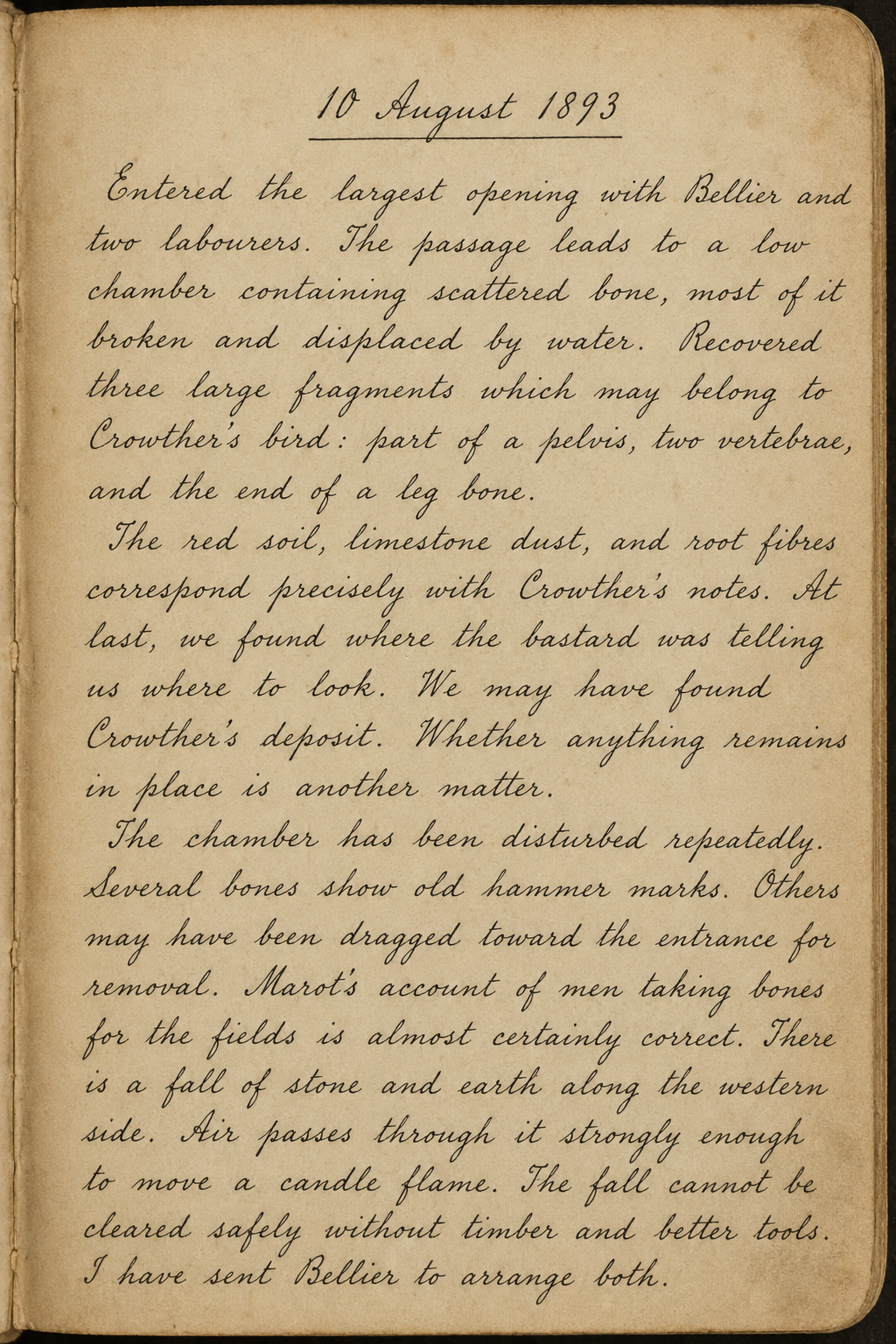
10 August 1893
Entered the largest opening with Bellier and two labourers. The passage leads to a low chamber containing scattered bone, most of it broken and displaced by water. Recovered three large fragments which may belong to Crowther’s bird: part of a pelvis, two vertebrae, and the end of a leg bone.
The red soil, limestone dust, and root fibres correspond precisely with Crowther’s notes. At last, we found where the bastard was telling us where to look. We may have found Crowther’s deposit. Whether anything remains in place is another matter.
The chamber has been disturbed repeatedly. Several bones show old hammer marks. Others may have been dragged toward the entrance for removal. Marot’s account of men taking bones for the fields is almost certainly correct. There is a fall of stone and earth along the western side. Air passes through it strongly enough to move a candle flame. The fall cannot be cleared safely without timber and better tools. I have sent Bellier to arrange both.