

The Wainwright Rediscovery
Mauritius, 1893
In 1893 the Society sent a field naturalist to Mauritius to settle an argument about a drawing. He came back with twenty-eight skulls, and the photographer he had hired came back with something the Society has held quietly for a hundred and thirty-three years.
The Society files this as no more than WE0. A number, a file, which tells you something about how this institution prefers to remember things. Acquired. Accessioned. Concluded. And now, released.
What follows is the story the file tells. Most of the documents are all in the Archive and I have linked them where they belong — they are better than my account of them, and they do not agree with each other in every particular, which I have decided not to tidy.
— Archer Wilder
The man they sent.
Peregrine Hartley Wainwright was the second son of a saddler and a schoolmistress, born in the Colony of Victoria in 1851 and raised mostly out of doors. He went by P. H. since he was a child, because he thought the full version sounded pretentious. He left Melbourne without finishing his zoology degree, but what he did finish was a two-year museum apprenticeship, and it was the only credential that ever mattered to him because it is where he learned how a record is kept (and how easily a curator revises an inconvenient label).
His first love was beetles. Coleoptera, and he would correct you if you said bugs. He believed, only half joking, that you could read the moral character of a place in its beetles.
In 1877 he published a paper describing something that did not conform to the existing record, and he was pressured to amend it. He did, though he later described that act as a “display of cowardice” was never able to leave forgive himself.
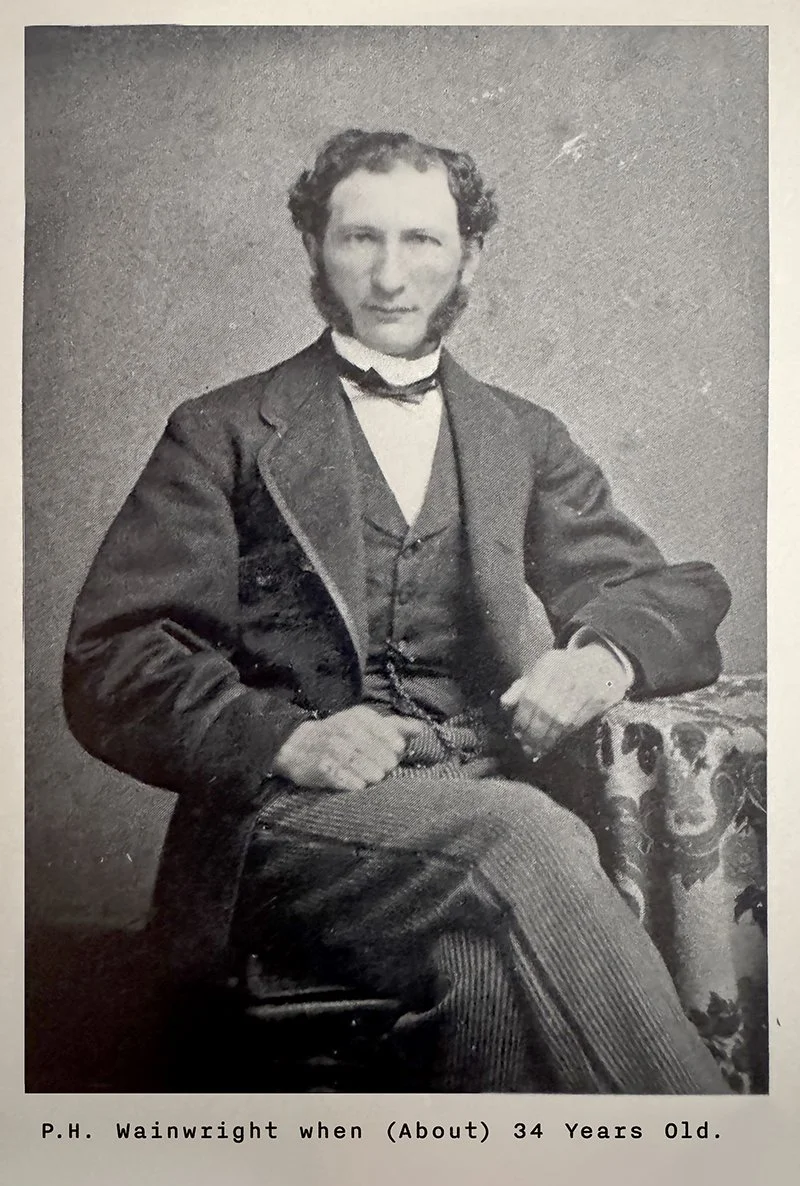

Wainwright’s took this beetle as his personal crest, and was known to carry an uncategorized specimen with him at all times.
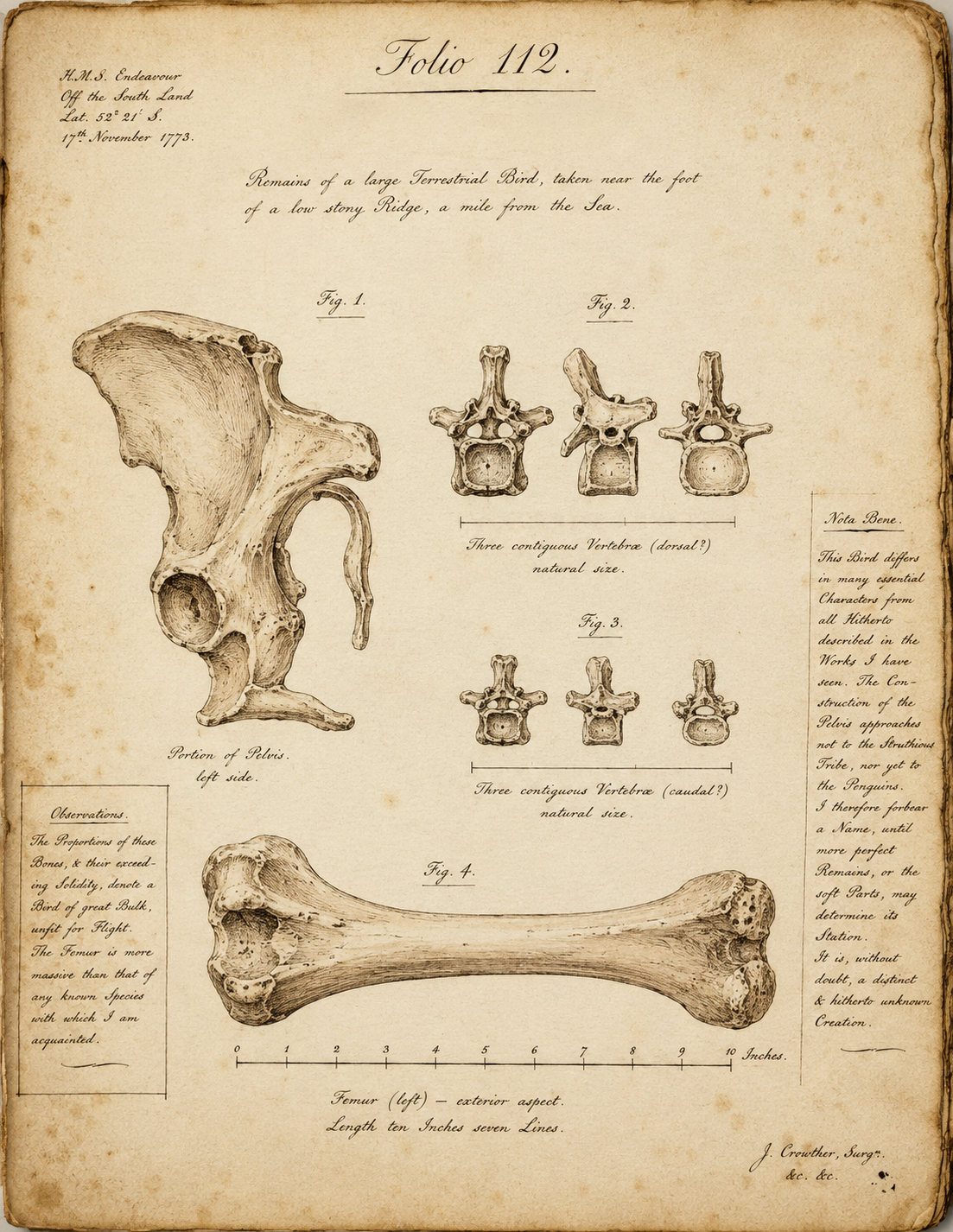
A drawing.
Crowther Notebooks, folio 112. Ink and wash. Subject unidentified by the artist.
A. Merrick Ashby had read Wainwright's paper in its first form, learned it had been quietly amended, and understood exactly what he was looking at. Coincidentally, he founded the Society in 1878 and Wainwright was a founding member before the year was out. For fifteen years afterward Wainwright filed official reports that were faithful in structure rather than in substance, and kept the substance in the margins of his own copies, where it maintained a modicum of secrecy.
Late in 1892 the Department of Zoological Records took up a set of drawings from the Crowther notebooks — “Crowther’s Bird,” Folios 112 through 126. Beatrice Holloway, Assistant Keeper, assessed them. Her conclusion narrowed the whole of Mauritius to a belt of inland limestone country and recommended a field inquiry.
The inquiry was approved early in 1893. Wainwright was forty-two.
Archive: Crowther Selected Folios · Assessment of the Crowther Drawings · Crowther Biographical Record · Expedition Authorization Telegram
The wrong ground.
He went with an interpreter, Auguste Bellier; a photographer, Edith Quincy, hired on commission and told very little; and two labourers whose names the file does not keep.
They began in the marshland beds that had been worked for fifty years — dodo bone lifted out by the ton, ground down, and sold as fertiliser, the extinction of a species converted into a soil amendment and shipped abroad at a profit. Whatever had been in that ground was largely gone, and what remained had been handled so many times it could prove nothing.
The journal covers those months without much patience for them.
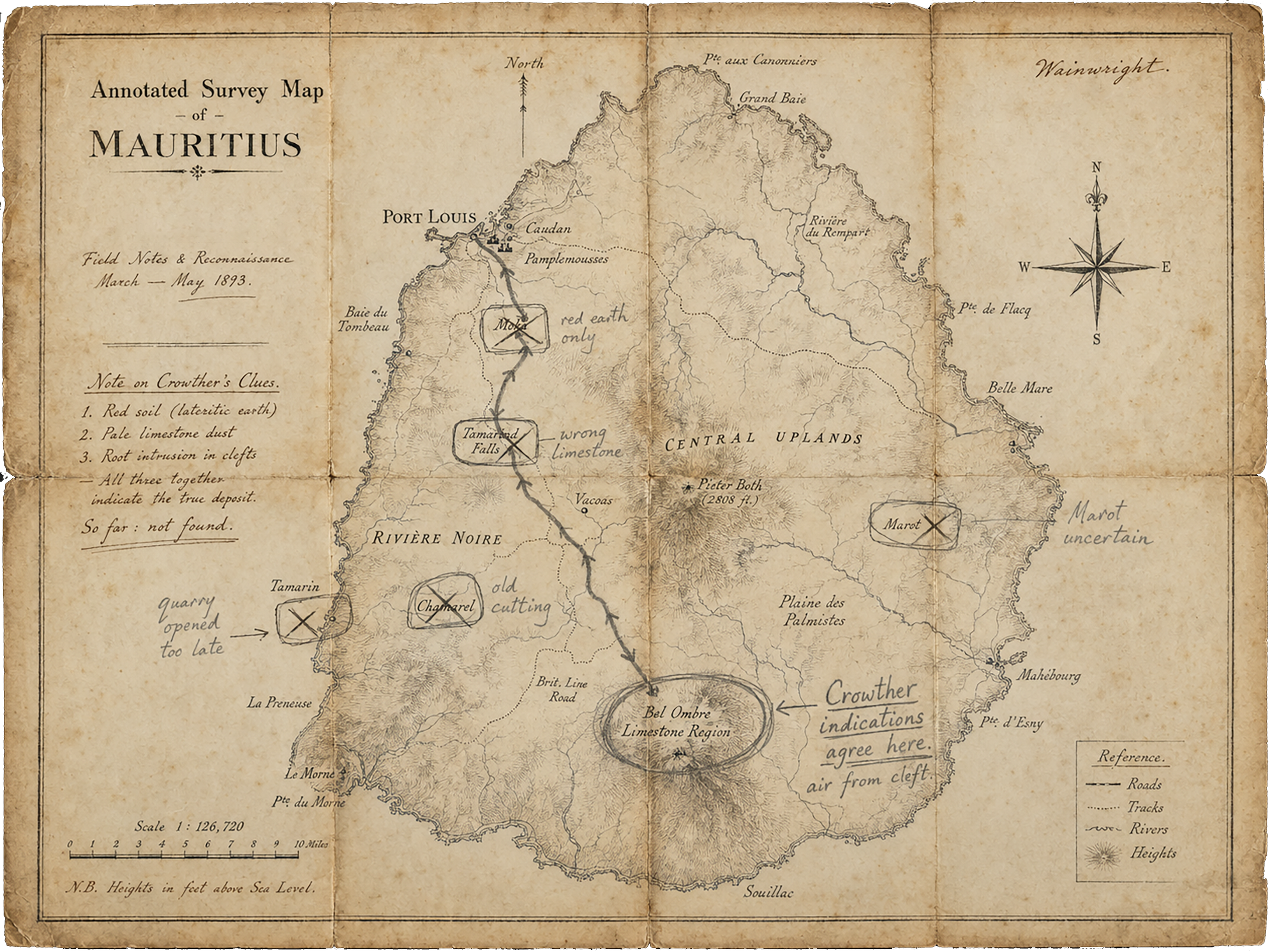
In June a man named Étienne Marot gave a statement at Rivière Noire. One of Wainwright’s main goals was to record all local testimony, however contradictory. Marot's was contradictory, but it was also specific, and it pointed inland, at limestone, which is what Holloway's assessment had said seven months earlier from a desk on the other side of the world.
And so, they turned inland.
Archive: Annotated Survey Map of Mauritius · Field Journal Excerpts · Mauritius Site Drawing
The chamber.
A second cutting, and then a bone chamber.
Quincy lit it with mirrors and a great deal of swearing and photographed the remains where they lay, before removal, from four angles — the first at Wainwright's insistence and the rest at her own, because she had noticed the same thing he had noticed.
Twenty-eight specimens. Raphus cucullatus, identifiable beyond any argument. He wrote that they were old. Then he wrote that they were not old enough.
The specimen tags record that the orientation of the remains in situ was considered atypical, and that no satisfactory explanation was entered. In the margin of his own copy, where the Society's clerks were not going to look, he wrote something else: This specimen did not want to leave the earth.
They closed the passage with loose stone and sent no message. Then, instead of going home, he kept looking.
Archive: Field Journal Excerpts · Mauritius Site Drawing
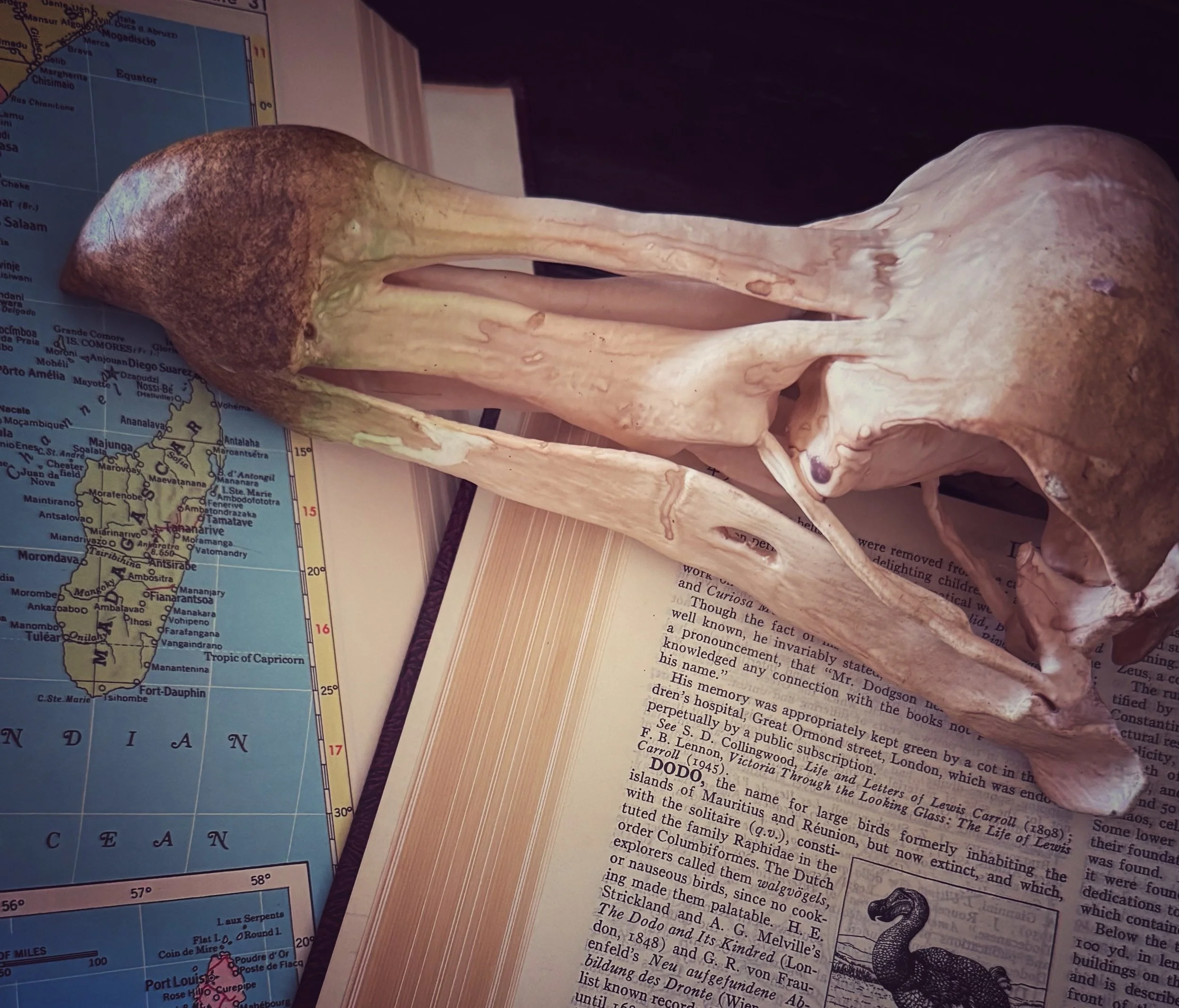
Caption: Cranial material, Raphus cucullatus. Recovered Mauritius, 1893. One of twenty-eight.
What Quincy photographed.
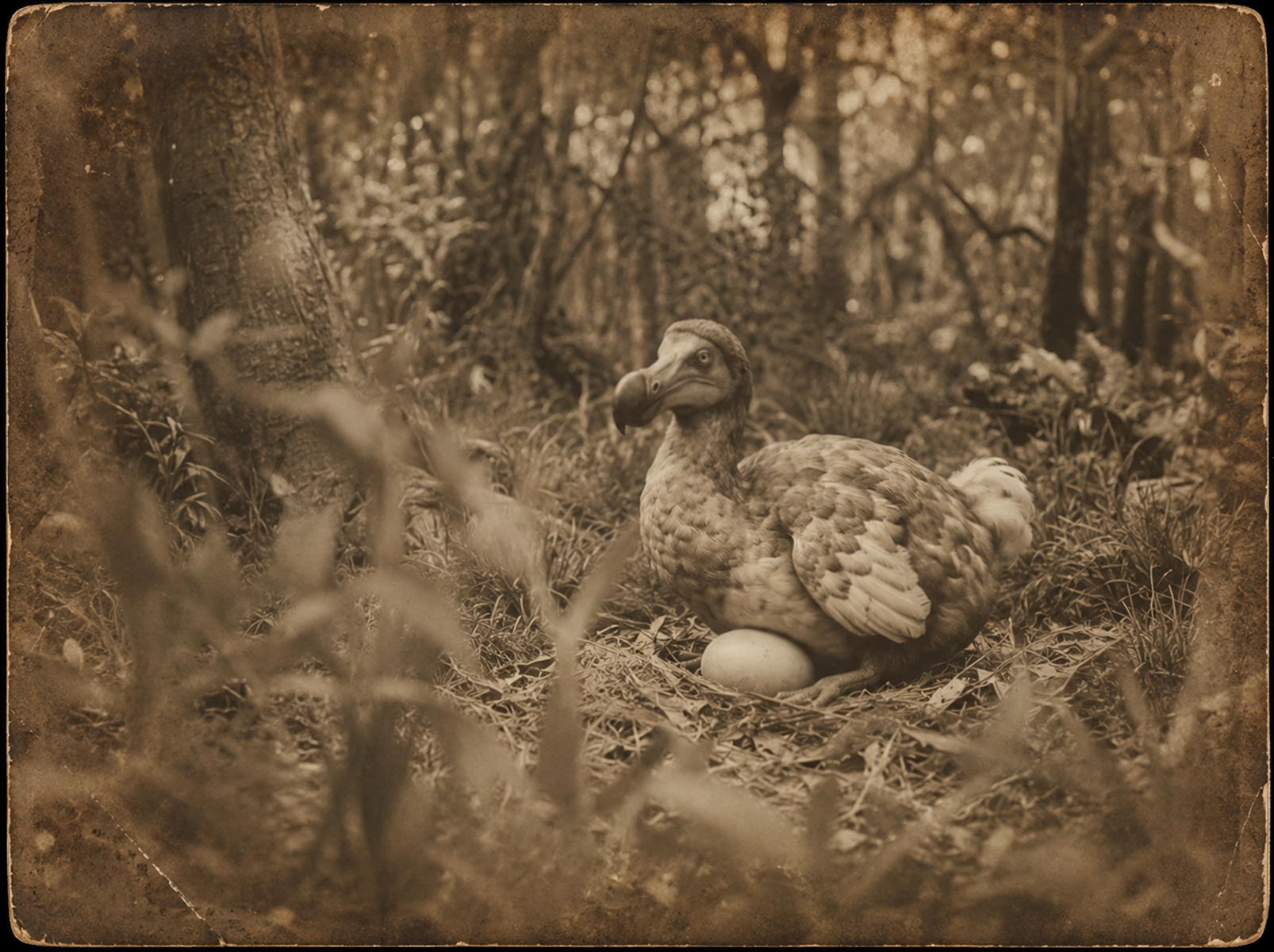
E. H. Quincy, 1893. Gelatin dry plate. Subject: Raphus cucullatus, adult on nest, one egg. Site withheld.
Somewhere else on the island, in scrub at the edge of a clearing, Edith Quincy set up a plate camera and photographed four living dodos. Later, and closer, she photographed one on a nest with an egg beneath it.
She was twenty-five, and she was paid eleven pounds for the entire commission. The plates were not developed in the field. They came home in her keeping rather than in the Society's cases, Wainwright's official report does not mention them at all, and how they reached the archive is not recorded anywhere in the file.
What is recorded is a line in her own working notes, written in Mauritius before a single plate had been developed, when she had nothing to go on but her eye and the ground glass:
> P.H.W. asked me whether the plate could be mistaken. I told him plates do not make mistakes. He said that was what he was afraid of.
She lived another twenty-four years and never told anyone.
Archive: The Quincy Plates
What arrived in London.
Two cases were sealed at Port Louis: cranial material, and one bound volume of field notes. They crossed to London and were opened before the Registrar.
In the straw, present and not declared, was a feather.
The Registrar's house style in such matters is a small marvel of institutional self-control. The item was retained, entered separately, and not catalogued against the consignment, and the obvious conclusion was not committed to paper pending a reply from the shipper.
There is no reply from the shipper in the file. What there is, instead, is an application.
Archive: [Record of Consignment] · [Accession Record, Form 11-C]
He went back.
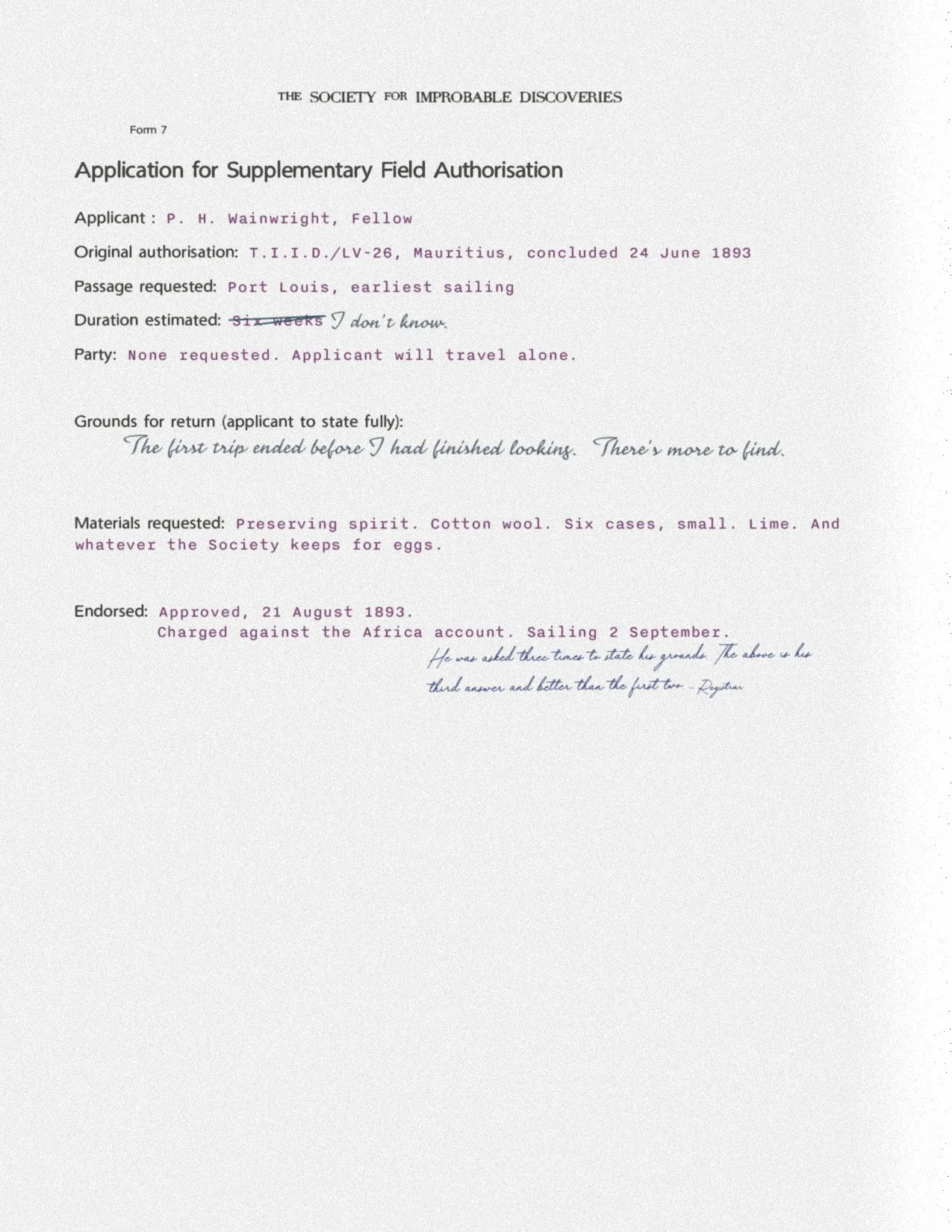
The application was for a supplementary field authorisation. It was approved and charged against the Africa account, and he sailed in September, alone.
The materials he requested were lime, six small cases, and whatever the Society keeps for eggs. Under duration he wrote: I don't know.
In December the Society's own report on the age of the skulls came back. Death most probably between 1806 and 1830 — a perfectly ordinary finding, except that the dodo was declared extinct in 1662, and 1806 is a hundred and forty-four years after the last one is supposed to have died. The report is careful, thorough, and does not once mention a photograph. There is no sign the committee that wrote it had ever been shown one.
All public disclosure was withheld.
Archive: Supplementary Field Authorisation · Report on the Age of the Wainwright Skulls · Research Note — Dodo
Why you are reading this now.
The Society has never published any of this. I want to be very clear about that, because people reach for the wrong word. The Society did not hide the dodo. It did not deny anything, alter anything, or take anything out of anyone else's record. It authenticated what it was given, entered it completely and honestly, and then said nothing for a hundred and thirty-three years — a different act, yes, and I would argue, a smaller one.
Article IV of the Charter had already anticipated me. An institution which holds the truth indefinitely, it says, becomes in time the instrument of its suppression. So Article V sets a clock at the moment of accession: the natural lifespan of everyone named in a recovery, plus not less than two full generations (and ideally, three). Wainwright is dead. Quincy is dead. Bellier, Marot, Holloway, the Registrar who declined to write down the obvious conclusion — all dead, and long enough dead that the interval has run.
Which means the holdings come out. Not published, or announced, or donated to anybody's collection. Released quietly and individually into private custodianship with the full record of their recovery, which is what the Charter says, and which I think is right. A specimen deserves a person, not a vault.
Twenty-eight skulls were recovered.
Tempus revelabit. — A.W.